
Bio/Archaeological Techniques and Research Center
BIOARCH CANADA

About the Course
Field Program Details
Location: Odorheiu Secuiesc (Székelyudvarhely), Harghita County, Transylvania, Romania
Program Dates:
Session 1: June 6 – July 2, 2027 (4 weeks)
Session 2: July 4 – July 30, 2027 (4 weeks)
Program Fee
Cost: $3,395 USD per 4-week session (non-credit option)
Fee Includes:
Registration and field fees
Lectures, field equipment, and laboratory gear
Accommodations and specified meals (Note: Academic credits/tuition are not included in the program fee.)
Accommodations
Participants stay in a charming, quiet hotel with 2 to 3 people per room and private en-suite bathrooms. The hotel is located a 10-minute walk from local shops and restaurants, and a 30-minute walk from the town center, where larger grocery stores and dining options are available.
Meals & Dietary Accommodations
Provided Meals: Hot breakfasts and dinners are served Monday through Friday at the hotel, featuring traditional Romanian and Hungarian cuisine.
Dietary Needs: We can readily accommodate vegetarian diets. Please note: We are currently unable to accommodate vegan or gluten-free diets.
Fieldwork & Practical Experience
Participants in the field excavation program receive comprehensive hands-on training, assisting in the recovery and documentation of human remains from start to finish. Working in pairs assigned to specific grave cuts, each team receives direct guidance through every stage of the excavation process.
Standard Field & Laboratory Tasks
Excavation & Documentation: Careful recovery of human remains, detailed note-taking, and standard hand-drawn plan mapping.
Processing & Curation: Skeletal removal, cleaning/washing, and laboratory curation practices.
Demographic Scope: Because these churches served entire local villages and towns, the skeletal assemblies represent broad demographic profiles across age and skeletal sex.
Work Expectations & Schedule
Grave Assignments: While field conditions vary, every team will complete at least one full skeletal excavation, with most teams completing two or more over the course of the session.
Lectures & Evening Activities: Evening sessions, workshops, and lectures complement field research themes and deepen learning.
Inclement Weather Policy: Rain days remain active workdays. Fieldwork will be supplemented with laboratory processing, lectures, or administrative tasks as needed based on current project priorities.
Living and Dying on the Edge of Europe Project: Székelyudvarhely's Story
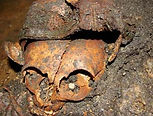
Transylvania (Erdély) is a historically rich region located in the heart of the Carpathian Basin in present-day Romania. Prior to World War I, Transylvania formed part of the Kingdom of Hungary, where the Székely people protected its eastern border for over a thousand years. Since 2013, ArchaeoTek has collaborated with the Haáz Rezső Múzeum, Dr. Zsolt Nyárádi, and members of the Székely descendant community to investigate this heritage through the systematic excavation of historic churches and mortuary landscapes.
Spanning a calibrated radiocarbon timeline from 1050 CE to the present, our findings reveal that while local communities were continually influenced by broader historical shifts, their ability to maintain cultural continuity was driven by deliberate, strategic choices rather than rural isolation.
Currently, our project encompasses two contemporaneous sites situated just 8 km apart. The Papdomb site in Văleni (Patakfalva) features a rural church and multi-phased cemetery where more than 1,000 interments have yielded an extraordinary 800-year dataset on rural village life. In contrast, the St. Nicholas (St. Miklós) site in downtown Odorheiu Secuiesc (Székelyudvarhely) provides an urban counterpart at the historical center of the "Seat of the Székelys." While sharing core mortuary traits with its rural counterpart, interments at St. Nicholas demonstrate notable variation, offering a rare window into comparing urban and rural community dynamics across medieval and early modern Transylvania.